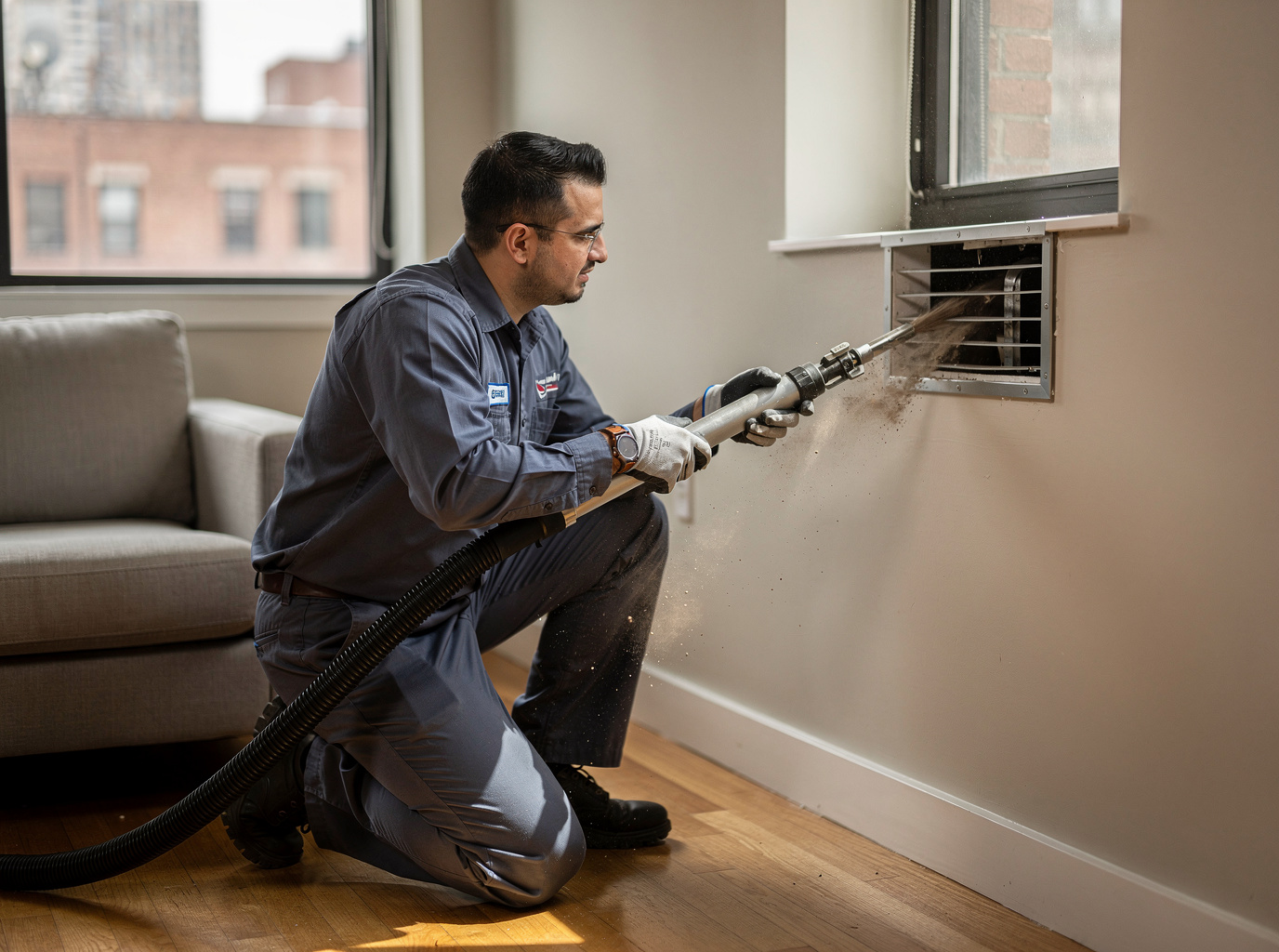
Jersey City row homes built before 1950 in Paulus Hook Historic District and Van Vorst Park often have narrow, uninsulated sheet-metal ducts that trap construction dust, insulation fibers and seasonal pollen. High summer humidity combined with winter heating cycles creates condensation points where mold colonies form inside the return runs, especially near Liberty Harbor and Bergen-Lafayette. Technicians must use negative-air machines sized for these tight access points rather than standard residential equipment to avoid pushing contaminants into living spaces.
In neighborhoods like The Heights and Greenville, many two-family homes share duct runs that cross property lines, requiring careful isolation before cleaning to prevent airflow between units. Exchange Place high-rises present a different challenge: vertical chases that collect construction debris from ongoing waterfront development. Cleaning these systems demands sectional brushes and HEPA-filtered vacuums rated for commercial static pressure so debris does not fall back into lower floors.
Homeowners in Journal Square and Newport frequently notice uneven heating after years of unserviced ducts because lint and pet dander restrict airflow near the furnace. A proper cleaning restores design CFM without replacing equipment, but only when the technician verifies damper positions and seal integrity afterward. Skipping this step leaves hot and cold spots that residents mistake for equipment failure.
Hudson County’s mix of brick and frame construction means exterior wall ducts are common; these runs are vulnerable to water intrusion during nor’easters. Spotting rust perforations during the initial camera inspection prevents future mold regrowth once the system is cleaned and returned to service.
Technician insight
In Jersey City the thing that catches most people out with Duct Cleaning is the narrow, unlined metal ducts running inside exterior brick walls in pre-war homes around Paulus Hook and The Heights. Summer humidity condenses on those cold surfaces during winter heat cycles, so simply vacuuming without addressing the moisture source lets mold return within one season.
The Heights Two-Family With Shared Returns
A homeowner in The Heights noticed dust on furniture despite new filters. Camera inspection showed heavy lint and pet hair in the shared return chase serving both units. After isolating the systems and performing negative-air cleaning, airflow readings returned to original design levels and the second-floor bedrooms stopped overheating.
Duct Cleaning Services We Offer
✓Whole Home Duct Cleaning
Removes accumulated dust and debris from supply and return runs in single-family and two-family homes common to Journal Square and The Heights.
✓Mold Remediation in Ducts
Targets microbial growth inside metal and flex ducts caused by Hudson County’s humid summers, using EPA-registered antimicrobial treatments after source removal.
✓Dryer Vent and Duct Cleaning
Clears lint buildup from dryer exhaust lines that often share chases with HVAC ducts in pre-war buildings around Paulus Hook Historic District.
✓Commercial Duct Cleaning
Services retail and office spaces at Newport Centre and Exchange Place where rooftop units push contaminants through long vertical risers.
✓Post-Renovation Duct Cleaning
Extracts drywall dust and construction debris from ducts after kitchen or bath remodels typical in Van Vorst Park and Liberty Harbor homes.
Duct Cleaning Cost in Jersey City, NJ
| Service | Typical Range | What Affects It |
|---|---|---|
| Standard Single-Family Duct Cleaning | $400–$650 | Typical 2–3 story home in Greenville or Bergen-Lafayette with basement access |
| Two-Family Or Row House Cleaning | $550–$850 | Shared walls and limited crawlspace access common in Paulus Hook and Van Vorst Park |
| Mold Treatment Add-On | $150–$300 | Applied after source removal when humidity-related growth is confirmed |
| Post-Renovation Debris Removal | $350–$550 | Extra passes required for drywall dust in recently remodeled Journal Square homes |
Ranges are typical for Jersey City, NJ and confirmed with an exact written quote before any work starts.
How it works
- 1
Camera Inspection
Technician runs a fiber-optic camera through accessible trunk and branch lines to map blockages and note rust or mold before any equipment is attached.
- 2
Register And Vent Sealing
All floor and wall registers in the home are sealed with magnetic covers to create a closed negative-pressure loop for the entire duct system.
- 3
Agitation And Extraction
Rotating brushes and compressed-air whips loosen debris while a truck-mounted HEPA vacuum pulls material out through the main return or a temporary access point.
- 4
Final Verification
Second camera pass confirms cleanliness, dampers are reset, and registers are reinstalled before the system is returned to normal operation.
Pricing
Most Jersey City homes fall between $400 and $750 depending on square footage, number of stories, and access restrictions in older row-house construction.